(Saturday, January 12, 2008)
Genre: Drama
Director: Anh Hung Tran
Staring: Tran Nu Yên-Khê, Nhu Quynh Nguyen, Le Khanh, Quang Hai Ngo, Chu Hung
Runtime: 112 min
Country: Vietnam
Release Date: 24 May 2000
Synopsis:
With the brilliant Vietnamese summer as a setting Vertical Ray of the Sun is beautiful from beginning to end. The plot centres around three sisters, two of whom are happily married (or so it appears). The youngest sister is single and living with her cute older brother, whom she is desperately in love with. A second sister is married to a man who has another woman and child elsewhere whom he loves just as much as his wife -with a few conditions, she agrees to carry on with the marriage. The third sister and her husband are overjoyed to discover she is pregnant, and though he is tempted, her husband remains loyal to her. Charming, slow-paced, face value, family saga film.
Movie Review:
You could say that this third feature by the director of the critically acclaimed The Scent of Green Papaya is about three sisters who conceal troubling truths beneath a smiling exterior; a movie concerned, in the manner of a conventional bourgeois novel, with keeping up appearances--and it's true, up to a point. But it's truer to say that The Vertical Ray of the Sun is more concerned with rethinking the art of filmmaking, and its real subject is form. Blending color, sound and mesmerizing images, it draws you into a luminous dream that unfolds with a hypnotic rhythm unique to Tran Anh Hung.
The actual story feels familiar, almost banal. Roving, unreliable men, the resilient women in their lives, an uneasy truce at the end, with rumblings of future trouble. The characters, based in Hanoi, form a community of artists--a writer, a photographer, an actor. Lien (Tran Nu Yen-Khe, Tran's wife, surpassingly beautiful and featured in all his films) plays the youngest sister, who shares an apartment with her actor brother and works as a waitress in the caf owned by elder sister Suong (Nguyen Nhu Quynh.) Lien seems more smitten with her handsome brother, with whom she flirts outrageously, than her sketchily drawn boyfriend. Suong is married to Quoc (Chu Ngoc Hung), a photographer who secretly keeps a second 'wife' and son in the country. (Suong has retaliated with an affair of her own.) The middle sister, Kanh (Le Khanh), is happily married to a writer and has just learned she's pregnant. The main drama probes the rifts in the two older sisters' marriages. Kanh's husband makes a trip to Saigon and is drawn to a mysterious temptress. He refrains, but his wife intuits his near-infidelity and the marriage begins to fray. And Suong's husband Quoc finally confesses his adultery to his wife (who has known all along), and after an anguished all nighter, they resolve to start over together.
The characters radiate a sweetness, delicacy and civilization (that makes all the more abhorrent American napalm not so long ago.) They revere family--the film opens with a memorial dinner for the sisters' mother and closes with one for their father, and they revere honor--the adulterous husband is torn in two by his duplicity. The sisters' closeness is conveyed by an overhead shot of their three dark, glossy heads bent over a task, bound together in complicity and laughter. And in a lovely scene, the two older sisters lie half-asleep in bed, while Suong semi-confesses her affair.
The star of the show, though, is Tran's use of color in a trance-like succession of images, each more gorgeous than the last one. The yellow/green/mauve tones of Tien's apartment invoke Bonnard (based in France since age 12, Tran has an esthetic that marries French to Asian); translucent green light through leaves could be the film's visual signature. And were walls ever this eye stopping? Tran likes them green/blue/aquamarine, usually with a splash of parrot-orange off to one side of the picture frame. Sometimes d.p. Mark Lee's camera reduces objects to pure color, as when a sunburst of yellow gobbles the screen--which turns out to be a duck readied for roasting. The purity and transparency of water is a visual refrain--characters washing; jade sea lapping against the hump-backed mountains of Quoc's country hideaway; and one show-offy close-up of water, black/blue/crystal splashing slo-mo in a bowl like frozen gems.
Though the film is quite reticient, the lush colors and foliage, Hanoi's heat and rain, and the beauty of the female actors combine to create a languor and sensuality that recall The Lover. The soundtrack adds to the atmospherics, combining the chirp of insects and birdsong with stoner music by The Velvet Underground and Lou Reed, with haunting Vietnamese songs and dissonant original compositions by Ton That Tiet.
Most arresting is the film's subtle narrative rhythm. Tran adopts a floating, somehow timeless all-at-once style, versus the more usual sequential approach of "This happened, then that, etc." It finds unity in recurring images (Tien and her brother waking up, flirting, doing their morning calisthenics) and twinned scenes--e.g., Quoc and his lover in the country is followed by a shot of his wife and her lover in Hanoi. Artfully placed jagged cuts shake things up. Tran never spells out, preferring swooping ellipses and abrupt transitions. When Quoc and his wife Suong reconcile at the end, we must do with a single potent image of the couple sitting propped against each other and asleep, exhausted by emotional strife.
Some Western viewers may prefer a more forward-driving style. Holes in the narrative fabric sometime make the plot points hard to follow. (On second viewing, the film's puzzle-pieces snap into place.) And Tien, though a figure of sinuous grace, feels underwritten--what is it with her and her boyfriend? But these are minor quibbles. Though Tran places special demands on his viewers, those prepared to enter his magical world will hunger to return.
Posted in
Posted by
Chavara Movie Fest
at
5:23 AM
(Friday, January 11, 2008)
SEPET
Genre: Romance / Comedy / Drama
Director: Yasmin Ahmad
Staring: Choo Seong Ng, Sharifah Amani, Linus Chung, Mei Ling Tan, Ida Nerina, Harith Iskander, Adibah Noor, Hoong Thor, Zehan Marissa
RunTime: 104 min
Country: Malaysia
Release Date: 24 February 2005

Synopsis:
19-year old Ah Loong is in charge of a stall selling pirated VCDs. Contrary to the stereotype of his social standing, Ah Loong, starring Ng Choo Seong, is an incurable romantic with an unlikely hobby - he loves to read and write poetry. Quite content to carry on being the Romeo of the slums, Ah Loong's life takes a sudden turn one day when a Malay schoolgirl, Orked, arrives at his stall. She is in search of films starring her favorite actor Takeshi Kaneshiro. Love blossoms between Orked and Ah Loong, although there are social and racial pressures that stand in their way. In the end, Ah Loong is involved in a motor vehicle accident while Orked is going to England to pursue her studies. It is not clear if he lived or died until the sequel, Gubra which shows that Jason really did die. After the credits finish rolling however, Orked is shown wearing a wedding ring sleeping beside Jason, who also has a wedding ring. In Mukhsin, Jason and the adult Orked are shown to be living together. However, the adult Orked is not called by her name in this scene as the young Orked is.
Movie Review:
When was the last time you saw a local movie in which a Malay girl and Char Siew appeared in the same scene? Writer-director Yasmin Ahmad's enigmatic Sepet pushed the frail envelope and fazed the mighty Censorship Board to (almost) no end. Ironically, the film - like its title - is a clever allegory of the narrow-mindedness afflicting present day Malaysian society.
Inter-racial relationships were previously explored within palatable context so as not to distress fragile audiences. In this genuine Malaysian film, Yasmin throws every stereotypes into the kitchen sink - a Malay scholarship recipient, a repressed Baba woman, a bigamous Chinese man, a Melayu Celup, a Chinese VCD peddler, a Tongkat Ali dependent - and even a road safety message. The only person missing is the Bhai guy. Out of it, comes an honest and brilliant film woven around a tragic love story.
Ng Choo Seong and Sharifah Amani play the star-crossed lovers whose parents are NOT the usual party poopers. Jason (or Ah Loong) is a VCD seller trapped in the inescapable underworld of protection and patronage. Orked harbours an unfulfilled fetish for slit-eyed hunks like Takeshi Kaneshiro. The objections to this unlikely relationship emanate from prejudiced peers, instead. Jason's best friend dissuades him with dreadful thoughts of circumcision and halal food. Orked's male friend calls her a slut cum bohsia and vilifies her for liking guys with mata sepet.
Unlike the spirited performance by Sharifah, fellow first-timer Ng was going through the motions until one particularly memorable scene. At the hospital where his best friend Ah Keong (Linus Chung) was recovering from a shark attack, the duo alternated seamlessly between Hokkien, Cantonese and English. Many of the (language) subtleties were unavoidably lost in the translated subtitles. This darkly funny scene centered on Malay girls in sarongs, Hang Tuah and the origins of the Babas; all skillfully done with a dash of the politically incorrect term - Huan Kia.
The introspective trio of Harith Iskandar, Ida Nerina (as the parents) and Adibah Noor (as the "servant") supplied many of the film's funnier and poignant moments. How this ménage à trois came about was not fully explained though. Nevertheless, Harith's amorous character spooked the Board too, I was told.
Yasmin described the enforced cuts as unreasonable beyond belief. In one scene, Jason said "Not all Chinese men cheat and not all Malay men are lazy". Orked's smug retort "That is where you are wrong; all Malay men are lazy" ended in the guillotine. The director explained that the whole scene was done tongue-in-cheek and it goes to show that Malays can joke about themselves.
Go watch this landmark Malaysian film before someone declares it immoral to laugh at ourselves.
Posted in
Posted by
Chavara Movie Fest
at
3:28 AM
BE WITH ME
Genre: Drama
Director: Eric Khoo
Starring: Theresa Chan, Ezann Lee, Seet Keng Yew, Chiew Sung Ching, Samantha Tan, Lynn Poh
RunTime: 1 hr 33 mins
Country: Singapore
Release Date: 8 September 2005
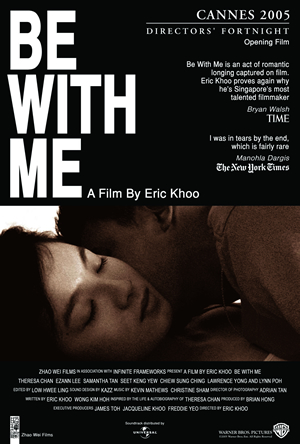
Synopsis:
“Be With Me” is a tapestry of stories woven around the themes of love, hope and destiny. The characters lead separate lives but are bound by one common desire - to be with their loved one. The protagonists in the movie are fictitious except for Theresa Chan, whose life story inspired “Be With Me.” Deaf and blind since she was 14, Theresa, now 61, has triumphed over her disabilities to live an amazing life.
Movie Review:
An elderly shopkeeper living the twilight of his years in loneliness. A timid security guard pining for unattainable love. A teenager experiencing love, and love lost. These are the 3 storylines intertwined in Be With Me, Eric Khoo's latest feature film which won accolades in Cannes 2005's Director's Fortnight. Inspired by the autobiographical life of Theresa Chan, who became blind and deaf, her tale props the others with inner strength, contrasting their fears and regrets with her courage to live life to the fullest despite her double handicap.
For the young adult audience, most should have no difficulty identifying with the puppy love stage in the So In Love segment. The initial passionate stage that lovers experience with each other, the insecurities that creep in, the fear of losing the other. As fast as love is established through a flurry of SMS messages and online chat sessions, as fast as love is lost through the cessation of communication.
Perhaps this segment is the most talked about, with the focus of love between members of the same gender. Jackie and Sam (note the androgynous names, played by Ezann Lee and Samantha Tan respectively) provide the eye-candy in a tale of modern young love. The expectation of reciprocation and committment from the other half may stifle the relationship, especially
when one is just experimenting with the other. Newcomer Samantha holds her own against the
performance of Ezann (who has TV experience), and without spoken dialogue, kudos to their performances in silence and through body language and facial expressions.
In "Finding Love", another rookie, Seet Keng Yew, stars as Fatty Koh, the timid security guard who admires Ann (played by Lynn Poh), an executive who works in the office he's guarding, from afar. Consciously aware of their social divide, he cannot bring himself to express his feelings for her, and takes to stalking her movements in the office, at play, and from the compounds of her home.
Love as seen from the perspective of the middle aged, this segment continues Eric Khoo's exploration of the working class in Singapore, following the heartlander life of Fatty, his neighbours, his unsupportive family (cult cameo favourite Lim Poh Huat appears with 3
spoken lines) and based in familiar settings like coffeeshops, HDB flats, and the kitchen.
Faced with the lack of courage for face to face communications, Fatty decides to write a letter to
Ann, and even has difficulties coming to terms with and putting down his feelings on paper. But when he finally does, the cruel hand of Fate deals a blow.
"Meant To Be" opens the film, where we see an elderly shopkeeper closing his store, and bringing the audience into the world of his private lonely life. The long wrinkled lines on his face tells you he has experienced much sorrow and loss. He cooks for himself and his wife, but the dishes remain simple. His son, a social worker, drops by only occassionally to visit,
and in one such visit, he brought along the story of Theresa Chan, inspiring his father, and through food, we see that the elderly man found new purpose in life, finally letting go of the loss and pain.
This segment is touted by many as the most powerful of all, as it mixes Theresa Chan's courageous story into itself. We wait with abated breath for the moment the two characters finally meet, and it is a scene so poignant in itself, with little said but just an embrace, bringing across forgiveness and soothe, and tears to many.
Fans of Eric Khoo's short films will know that the elderly man, played by Chiew Sung Ching, had starred in an earlier short film "Symphony 92.4FM", a role in which calls for an acting range quite similar to the one in Be With Me, a role written by Eric with Chiew specifically in mind, spending 6 months tracking him down to star in this film.
We've seen each character faced with communication challenges, and each are without physical handicap. And here lies the strength of Theresa Chan's story. Be With Me is essentially a silent film, and the use of subtitles to narrate the story of Theresa brings close to home an example of how silent and dark Theresa's world is. Physically that is. Which doesn't stop the strong lady's indomitable will to live life to the fullest, and to help others along the way.
It is simply amazing to see her go about daily chores with ease, and taking on mentorship roles in being a teacher in the school for the blind. It makes the audience sit up and ponder about life, and the naturally tendency to take our senses for granted, of being unfulfilled with many unnecessary wants and desires, forgetting the simple pleasures of life and living life.
Never had a local film touch so many facets of life, in love, sorrow, loss and inspiration. Be With Me is truly a masterful classic which commands a place in Singapore's film history. Watch this.
Posted in
Posted by
Chavara Movie Fest
at
3:21 AM
(Thursday, January 10, 2008)
Date: 19-01-2008
Venue: Chavara Cultural Centre Auditorium
Films
Posted in
Posted by
Chavara Movie Fest
at
5:13 AM