(Saturday, March 8, 2008)
Genre: Drama
Director: David Riker
Language: English / Spanish
Runtime: 88 min
Country: USA Release
Date: 7 July 2000
 Synopsis
 La Ciudad is a wonderful, and beautiful movie with twisting story lines. Its black and white imagery gives us a feeling of being there; the vacant lot along the East River waterfront, the empty lot in Bushwick, the streets of Mott Haven, the sweatshops. I will say that my opinion of the movie is slightly tainted. I got to view it at New York's Museum of the Moving Image and met the director afterwards to talk about the film's unique production. Filmed over years, using black and white film was actually a necessity in order to create consistancy in lighting. The stories that make up the film's parts were developed by the actors shown in the film; which may explain its lack of any Hollywood-type ending
Posted in
Posted by
jmj godville
at
4:56 AM
Genre: Comedy / Drama / Romance
Director: Fernando Meirelles, Kátia Lund
Language: Portuguese
Runtime: 130 min
Country: Brazil / France / USA
Release Date: 30 August 2002
Synopsis
Taking place over the course of over two decades, City of God tells the story of Cidade de Deus (Portuguese for City of God), a lower class quarter west of Rio de Janeiro. The film is told from the viewpoint of a boy named Rocket (Busca pé in Portuguese) who grows up there as a fishmonger's son, and demonstrates the desperation and violence inherent in the slums. Based on a real story, the movie depicts drug abuse, violent crime, and a boy's struggle to free himself from the slums' grasp.
The movie begins cinematically depicting chickens being prepared for a meal. A chicken escapes and as an armed gang chases after it bumps into Rocket who believes that the gang wants to kill him. The movie then flashes back ten years earlier, to tell the story of how he got himself into that position.
Posted in
Posted by
jmj godville
at
4:35 AM
Genre: Action / Drama / Romance / Sci-Fi / Thriller
Director: Fritz Lang
Language: German
Runtime: 153 min
Country: Germany
Release Date: 13 March 1927

Synopsis
The film contains a scene where Maria retells a variation of the story of the Tower of Babel from the Biblical book of Genesis, but in a way that connects it to the situation she and her fellow workers face. The scene changes from Maria to creative men of antiquity deciding to build a monument to the greatness of humanity and the creator of the world, high enough to reach the stars. Since they cannot build their monument by themselves, they contract workers to build it for them for wages. The camera focuses on armies of workers led to the construction site of the monument. They work hard but cannot understand the dreams of the Tower's designers, and the designers don't concern themselves with the mind of their workers. As the film explains, "The dreams of a few had turned to the curses of many". It then ironically inverts the original story's conclusion, noting that the planners and the workers spoke the same language but didn't understand each other. The workers revolt and in their fury destroy the monument. As the scene ends and the camera returns to Maria, only ruins remain of the Tower of Babel. This retelling is notable in keeping the theme of the lack of communication from the original story but placing it in the context of relations between social classes
Posted in
Posted by
jmj godville
at
4:18 AM
Genre: Documentary
Directors: Asger Leth, Milos Loncarevic (co-director)
Language: Haitian / English / French
Runtime: 88 min
Country: Denmark / USA
Release Date: 20 July 2007

Synopsis
This documentary takes viewers into the dangerous slums of Cité Soleil in Haiti, where gang leaders rule the daily lives of families living there. Two of these gangsters are both brothers and aspiring rap stars. Yet they both battle each other for control of the streets and for the love of the same woman. Features a score by Wyclef Jean.
Posted in
Posted by
jmj godville
at
3:47 AM
(Friday, February 1, 2008)
Genre: Comedy / Drama / Romance
Director: Pat O'Connor
Language: English
Runtime: 119 min
Country: USA
Release Date: 16 February 2001

Synopsis
Based on the screenplay by Herman Raucher for the 1968 film of the same title, SWEET NOVEMBER stars Charlize Theron and Keanu Reeves in the story of an experimental love affair. Theron is Sara, a free-spirited woman who runs across tight-laced ad executive Nelson (Reeves) at the DMV. Nelson wants only to be left alone to continue on the fast track of his career, but Sara is drawn to him. She makes him an offer: to be her November, the man who will live with her for one month only, during which she will "help" him. Not sure why, Nelson accepts, finding that Sara appeals to something he didn't even know was inside him. As she begins to change his life, Nelson realizes what he's been missing in his career-centered world--but just as he begins to reach out to her, Nelson finds that Sara has secrets of her own.
Movie Review
"Sweet November" may be a work of romantic hokum about a savage power-yuppie who learns to slow down and discover love in the arms of a quirky, perky girl with a tragic secret -- but as such sappy movies go, this is one that hits all the right notes.
Keanu Reeves and Charlize Theron proved they have couples chemistry as husband and wife in "The Devil's Advocate." Here they do the opposites-attract thing with great success and use their charisma to overcome what by all rights should be a script full of romantic clichés.
Reeves plays shallow, ruthless, arrogant ad industry hotshot Nelson Moss, who shows his astronomical self-centeredness in the picture's opening scene. It's early morning and he's having sex with his girlfriend -- until his alarm clock goes off. The second it does, he says "thanks, that was great" before jumping up, walking across his uber-modern high-rent loft, turning on his entire wall of high-tech TVs and brainstorming an ad campaign for a major client.
Theron plays Sara Deever, a San Francisco "free spirit" who has a strange habit of taking in stray men who are psychological fixer-uppers. She moves them into her North Beach apartment for one month, uses her unexplained gift for metaphysical bandaging to set them right, then moves on to the next fella.
When these two meet during a debacle at the Department of Motor Vehicles, Sara immediately sees in Nelson her most challenging project yet and begins hassling him to move out of the Sharper Image condo and into her funky, low-rent walk-up for 30 days.
He, of course, thinks she's nuts. But when he loses a multi-million dollar account (by proposing a highly sexualized campaign for a family-oriented hot dog company), gets fired and his much-neglected girlfriend moves out -- all on the same day -- he succumbs to Sara's badgering. He figures, at least for the moment, he hasn't anything to lose.
Theron is perfectly cast as the effervescent Sara, who seems to have double-dipped in the joie de vivre. She completely inhabits her character's contagious carefree charm, making the audience fall in love with her even faster than Nelson does. Theron provides the character an esoteric depth, giving her man-a-month habit a nagging feeling of desperate compulsion.
She's also the ideal foil for Nelson's funless, judgmental glibness. Sara can so easily and cheerfully slap his ego down that she makes him nervous. She's the kind of grown-up girl who does cartwheels on the beach while he watches with his hands thrust misanthropically in his pockets.
Reeves, who has become much better at picking roles that suit him, fits well into Nelson's supercilious skin. He really turns on the hubris in the scenes that lead to him getting fired. He also does a fine job projecting the unaccustomed abashment Nelson feels when Sara takes charge of his life.
As their month together progresses, his transformation into a stop-and-smell-the-roses guy under her tutelage is altogether quite winning. Too bad he's so unconvincing when it comes time for this movie's "you complete me"-type romantic climax.
But director Pat O'Connor ("Circle of Friends," "Inventing the Abbotts") never lets the movie's hackneyed conventions (Nelson revisiting his unhappy childhood, Sara's gay best friend) steamroll over the magnetism between his stars.
Romance movie protocols are followed (a passionate argument in the rain, a bubble bath for two), but seasoned with a touch of imaginative enthusiasm. Dialogue is amusingly sassy, but not overindulgently clever. O'Connor even keeps the story's fateful, tearjerker plot turn on a short leash, playing the heartstrings obligingly but tenderly.
"Sweet November" (which, by the way, is a remake of a 1968 movie of the same name) may have an obvious story arc. It may, at its core, be a textbook chick flick punctuated by a soundtrack of smoky-voiced girly alt-pop anthems
But it is sweet. It is eminently romantic, warm and satisfying. And even if Keanu's heart-rending tears in the last reel look suspiciously like special effects, this is a movie likely to inspire the real thing in the softies in the audience. And even we cynics will feel a little warm and fuzzy when the credits roll.
Posted in
Posted by
Chavara Movie Fest
at
12:00 PM
Genre: Comedy / Crime / Drama / Romance
Director: Jae-young Kwak
Language: Korean
Runtime: 123 min
Country: South Korea / Hong Kong
Release Date: 3 June 2004
 Synopsis
When police officer Kyungjin met with Myungwoo accidentally in a crime, she found that this responsible teacher was a really nice guy. At that night, Kyungjin got into a fight with a bunch of high school kids and got trouble in a big gun fight between rival drug dealers. Myungwoo tried to help her but then something happened that forces them stayed together all day long. They got closer to each other and Myungwoo was not able to repulse the strange but pure nature. He fell in love with her. One day, when Kyungjin was chasing a notorious criminal, Myungwoo helped her again, however, not knowing that what would happen that day changed their relationship forever...
Movie Review
WINDSTRUCK is directed by the same man who gave us MY SASSY GIRL and also the leading actress is ‘my sassy girl’ herself, Jeon Ji-hyun. It’s inevitable that there will be comparisons between the two films. While those judgments will certainly be unfair, you would think the director would take the extra step and cook up something new to the genre he revived so beautifully three years ago. You would think…..but let’s avoid those connections for now.
Ji-hyun’s performance has really blossomed with each film she makes. WINDSTRUCK really shows the wide range of emotions she can whip out on command and its no surprise she delivers another stellar performance. The surprise here is Jang Hyuk. Even though he’s starred in other films, I could never shake off him being anyone but Kyeong-su Kim from VOLCANO HIGH. But with this flick, he’s proven me wrong. His performance in the first half of the film is an absolute joy to watch. He’s sweet but also just rebellious enough to Ji-hyun’s character that you can’t help but fall in love with him too. In the acting-department, this film gets a well-deserved ‘A.’
Another word of warning: from this point on, potential spoilers may come pop up every now and then. They’re not major, but if you ignored my first warning and still want to have an un-biased view on the film, you REALLY need to stop here.
Although the two actors are convincing, I can’t help but feel their relationship is the Diet Pepsi version of MY SASSY GIRL. The first thing that happens is Kyungjin beats up Myungwoo. It gets laughs but it seems just a bit too familiar. So throughout the first hour, Myungwoo gets beaten, hand-cuffed, beaten some more, and burned. While he definitely puts up a verbal fight, in the end, he submits to Jyung-Hi’s all-too-adorable smile. While it’s certainly entertaining to watch, the two of them just slip into the two prototypical roles that MY SASSY GIRL has set up for most of Korea’s romantic comedies. By no means is it a crime, but you feel a little let down that nothing new was offered for quirky relationships on-screen. Well, the moment the first hour ends, so the clashes of opinions begin.
When the second hour starts, the film doesn’t just take a U-turn, it takes a U-turn and then drives off the road, plummeting over a cliff but then spreads its robotic car wings at the last second and flies into the clouds. We know the lovey-dovey romance the two engage in is in vain because the first thing the film tells us is that tragedy will strike. Knowing that something awful will eventually happen, the audience will probably try and not to become attached to any of the characters, and be ever worrying that the heart-aching situation will just be around the corner. When it finally does happen, the absurdity bar rises.
The film goes from a MY SASSY GIRL clone (a just as sexy clone), and becomes this DRAGONFLY-ish drama (Yes, that awful one with Kevin Costner) slathered with some DIRTY HARRY (Yes, that Clint Eastwood one). Many people may see a girl’s depressingly romantic heartbreak, but I see a girl who is coping with a loss by going a bit crazy. Not only is there a monkey wrench thrown into the story, but also the tone of the film. While MY SASSY GIRL provided a great outlet for the director to explore other genres via the cute screenplays, WINDSTRUCK suffers from a severe case of genre-identity crisis. Kyungjin’s tough but sweet law enforcer turns into a bad-ass detective who doesn’t give a shit about living and abides by reckless methods of enforcing the law (The only thing missing is a drinking problem and messy apartment). Rather than having a messy apartment though, Kyungjin’s apartment is decorated to the brim with origami windmills to sense the spirit of Myungwoo. It’s nice she loves him so much….but it’s kind of creepy. I mean come on, if you walked into a girl’s house and you saw origami windmills everywhere to connect with her old boyfriend, wouldn’t you be a bit spooked?
Everything just takes a turn for the soul-crushingly corny in the second half. From the slow-motion explosion to the numerous takes of Jyung-hi uttering Myungwoo’s name in tears, I thought it couldn’t get any worse. Then the “pay-off” arrives and while I did feel the tiniest water molecule forming in the corner of my eyes, but promptly disappears when I realize how absurd it is. I wanted to laugh, but I was also sad, so the two antagonizing emotions knocked each other out and I just ended up feeling nothing. While I’m recuperating from the resolution of the situation, my attention was suddenly diverted to the ending. Completely unexpected, the ending swept me off my feet. During the moment, I thought it was the coolest thing, but when the credits rolled, something just wasn’t right. What was Jae-Young Kwak’s intention with the ending? Was he reminding us of a better work? Was he trying to connect the two films together both spiritually and emotionally? Was he not confident in WINDSTRUCK enough that he had to go “Hey, remember this? Yea, that was pretty sweet huh?” I don’t know the answer, but the ending is still a treat, albeit if it is somewhat ambiguous.
Posted in
Posted by
Chavara Movie Fest
at
12:00 PM
Genre: Drama / Romance
Director: Takeshi Kitano
Language: Japanese
Runtime: 114 min
Country: Japan
Release Date: 12 October 2002

Synopsis
Matsumoto and Sawako were once a happy couple that seemed destined for marriage. But the age-old pressures of meddling parents and success forced the young man to make a tragic choice. She now wanders around in a mindless daze, bound safely to Matsumoto by a long red cord. To curious eyes, they roam aimlessly. But Matsumoto and Sawako are on a journey in search of something they have sadly forgotten. A journey that will cover the four seasons...
Hiro is an aging yakuza boss. Although surrounded by respect and affluence, Hiro is alone and his health is failing. As a young man, he was a poor factory worker with a loving girlfriend who brought him lunch in the park. But he abandoned her to search for his dreams of making it big. Now, decades later, he is mysteriously drawn back to the park where they used to meet...
Haruna Yamaguchi spends a lot of time on an isolated beach, looking at the sea. Her beautiful face is half-covered in bandages. Not long ago, before the accident, Haruna was a successful pop star who lived alone in a glamorous world of TV shows and autograph sessions. Millions adored her, longed to be close to her. Nukui is probably her most devoted fan. He has come today to prove it...
Three contemporary stories inspired by the everlasting emotions expressed by the precious dolls of Bunraku theater. Three stories delicately intertwined by the beauty of sadness. Three stories of undying love.
Movie ReviewDolls” is a film which represents a change of pace for legendary Japanese filmmaker Takeshi Kitano, a man best known in the West for his violent, often abstract gangster epics. “Dolls” represents the first time Kitano has chosen not to appear in a self-directed effort in 6 years, a decision which may well have been made to help distance audiences from the unavoidable associations made with his usual roles. This was probably a good idea, as “Dolls” is a very different proposition indeed, a collection of three stories, all of which are meditations on the crueler side of love, and the bitter emotions of guilt and blind devotion which so often drive human passion. Although there is some violence, and the inevitable inclusion of a Yakuza-themed sub plot, the film is a moving work of fragile beauty, with some truly stunning imagery, and which ranks amongst the director’s best.
The film begins with scenes of ‘bunraku’ puppetry, an ancient form of storytelling from Japan, which Kitano goes on to use several times as a thematic link, showing the characters at the mercy of their all-consuming hearts. The narrative takes the form of an at times surreal triptych, starting with the tale of the ‘bound beggars’, two silent lovers who wander the countryside, tied together with a long red piece of rope. As we learn more about the events which brought them to this sad destiny, the film gradually begins the second tale, that of an aging Yakuza boss haunted by a lost love from his past, and offered what seems to be a second chance. This in turn leads into the final story, which centres upon a once beautiful pop singer, disfigured by an accident, who comes into contact with an obsessive, lovesick fan.
The narrative is skilfully woven, and Kitano (who also wrote the script) manages to make the plot well structured, yet almost dreamlike, and the three tales at times feel more like allegories than anything else. This approach lends itself perfectly to the film’s thoughtful, explorative nature, and manages to be both intelligent and refreshingly open without ever sliding into pretension or artistic incomprehensibility. Most importantly, although the characters are somewhat sketchily written, having the overall impression of being cipher-like puppets, their emotions are truly heartfelt.
As a result, the film is very moving and incredibly sad, as Kitano allows cruel fate, as well as the weaknesses of the characters to bring tragedy crashing down, time after time. The most rewarding aspect of “Dolls” is that Kitano gives no easy answers, or indeed clear signs as to what the viewer is meant to be taking from the characters and their sad destinies. There are no emotional cheap shots or obvious resolutions, and this lack of moral judgment gives plenty of stimulating interpretive freedom.
In addition to such emotional resonance, “Dolls” is visually stunning, and the work of cinematographer Katsumi Yanagishima (who also worked with the director on “Zatoichi” and “Sonatine”, as well as the likes of “Battle Royale”) is comparable at times to that of Christopher Doyle’s work in “Hero”. The Japanese countryside is brought to life with a wonderful array of muted colours, which at times flare into passionate explosions in a way which truly enthralls. The landscape is treated like an artist’s canvas, and the film’s beauty is such that it almost becomes a piece of visual poetry. Kitano utilises this splendour, harnessing its power by imbuing it with a complex symbolism which reflects the emotions of the characters, often in the absence of dialogue.
Unfortunately “Dolls” is a film which also has its flaws, chief amongst which is the slow pace. Although the proceedings are thoughtful and engaging, there are inevitably long stretches where little happens. Whilst the film’s visuals ensure that these intervals are far from being worthless, the plot and characters do at times feel somewhat forgotten. Along with the film’s abstract musings, “Dolls” is likely to disappoint many of the director’s regular fans, or those expecting explosive action. Although there is some violence in the film, they generally take place off screen, and Kitano chooses instead to focus on their aftermaths, and the emotional suffering they cause, rather than on the violent acts themselves.
For those who enjoy thoughtful, challenging cinema, “Dolls” is highly recommended, as a film of great beauty and sensitivity which will also challenge both the heart and mind. A hugely rewarding and brave move for Kitano, 2002’s “Dolls” serves to cement his status not only as a film maker of high repute, but indeed as an artist who deserves recognition beyond the cult following he has amassed in the West for his gangster films.
Posted in
Posted by
Chavara Movie Fest
at
12:00 PM
Genre: Drama / Romance
Director: Leos Carax
Language: French
Runtime: 125 min
Country: France
Release Date: 2 July 1999
 Synopsis
Simply put, LOVERS ON THE BRIDGE is one of the most exhilarating motion pictures of the 1990s. In building a replica of the famed Parisian Pont-Neuf bridge, Carax's film became the most expensive French film ever produced, up to that point. This budget controversy threatened to overshadow the film itself, which has slowly begun to garner the proper recognition it deserves (thanks to Martin Scorsese and Miramax's American rerelease in the summer of 1999). Lavant portrays Alex, a drug-addicted, fire eating homeless man who lives on the deserted bridge, which is being restored for the French Revolution Bicentennial Celebration. When Michele stumbles into his life, a desperate, passionate relationship unfolds. Michele is an artist who is losing her eyesight due to a bizarre disease. But plot isn't the issue here. The sheer visual spectacle is. Shifting from brutal documentary to romantic melodrama to surrealism, Carax's THE LOVERS ON THE BRIDGE is an electric, powerful, poetic picture.
Movie Review
Extravagantly romantic and willfully overblown, The Lovers on the Bridge has become legendary in film buff-dom not only for its unwieldy mix of gorgeousness and incoherence but also for its history: Completed nearly a decade ago by then-39-year-old French auteur Leos Carax, it has been unreleased in the U.S. until now.
Surely distributors have stood behind far more addled and less fascinating artwork than this. Set during the French bicentennial of 1989 when the crumbling Pont Neuf, Paris' oldest bridge, was closed for repairs, Lovers chronicles the mad-passionate romance of Michele, a memory-haunted artist losing her eyesight (Juliette Binoche), and Alex, a derelict who moonlights as a fire-eating street performer (Denis Lavant). The bridge is their homeless home and their bridge to each other. And when sparks fly, the sky lights up, literally: Carax's most grandiose daredeviltry -- besides building a replica of the Pont Neuf in the south of France -- is a sequence in which fireworks go off as the lovers steal a speedboat and zoom up the Seine. At one point, Michele cavorts on water skis. To ask why is, apparently, to miss the boat. B
Posted in
Posted by
Chavara Movie Fest
at
12:00 PM
(Saturday, January 12, 2008)
Genre: Drama
Director: Anh Hung Tran
Staring: Tran Nu Yên-Khê, Nhu Quynh Nguyen, Le Khanh, Quang Hai Ngo, Chu Hung
Runtime: 112 min
Country: Vietnam
Release Date: 24 May 2000
Synopsis:
With the brilliant Vietnamese summer as a setting Vertical Ray of the Sun is beautiful from beginning to end. The plot centres around three sisters, two of whom are happily married (or so it appears). The youngest sister is single and living with her cute older brother, whom she is desperately in love with. A second sister is married to a man who has another woman and child elsewhere whom he loves just as much as his wife -with a few conditions, she agrees to carry on with the marriage. The third sister and her husband are overjoyed to discover she is pregnant, and though he is tempted, her husband remains loyal to her. Charming, slow-paced, face value, family saga film.
Movie Review:
You could say that this third feature by the director of the critically acclaimed The Scent of Green Papaya is about three sisters who conceal troubling truths beneath a smiling exterior; a movie concerned, in the manner of a conventional bourgeois novel, with keeping up appearances--and it's true, up to a point. But it's truer to say that The Vertical Ray of the Sun is more concerned with rethinking the art of filmmaking, and its real subject is form. Blending color, sound and mesmerizing images, it draws you into a luminous dream that unfolds with a hypnotic rhythm unique to Tran Anh Hung.
The actual story feels familiar, almost banal. Roving, unreliable men, the resilient women in their lives, an uneasy truce at the end, with rumblings of future trouble. The characters, based in Hanoi, form a community of artists--a writer, a photographer, an actor. Lien (Tran Nu Yen-Khe, Tran's wife, surpassingly beautiful and featured in all his films) plays the youngest sister, who shares an apartment with her actor brother and works as a waitress in the caf owned by elder sister Suong (Nguyen Nhu Quynh.) Lien seems more smitten with her handsome brother, with whom she flirts outrageously, than her sketchily drawn boyfriend. Suong is married to Quoc (Chu Ngoc Hung), a photographer who secretly keeps a second 'wife' and son in the country. (Suong has retaliated with an affair of her own.) The middle sister, Kanh (Le Khanh), is happily married to a writer and has just learned she's pregnant. The main drama probes the rifts in the two older sisters' marriages. Kanh's husband makes a trip to Saigon and is drawn to a mysterious temptress. He refrains, but his wife intuits his near-infidelity and the marriage begins to fray. And Suong's husband Quoc finally confesses his adultery to his wife (who has known all along), and after an anguished all nighter, they resolve to start over together.
The characters radiate a sweetness, delicacy and civilization (that makes all the more abhorrent American napalm not so long ago.) They revere family--the film opens with a memorial dinner for the sisters' mother and closes with one for their father, and they revere honor--the adulterous husband is torn in two by his duplicity. The sisters' closeness is conveyed by an overhead shot of their three dark, glossy heads bent over a task, bound together in complicity and laughter. And in a lovely scene, the two older sisters lie half-asleep in bed, while Suong semi-confesses her affair.
The star of the show, though, is Tran's use of color in a trance-like succession of images, each more gorgeous than the last one. The yellow/green/mauve tones of Tien's apartment invoke Bonnard (based in France since age 12, Tran has an esthetic that marries French to Asian); translucent green light through leaves could be the film's visual signature. And were walls ever this eye stopping? Tran likes them green/blue/aquamarine, usually with a splash of parrot-orange off to one side of the picture frame. Sometimes d.p. Mark Lee's camera reduces objects to pure color, as when a sunburst of yellow gobbles the screen--which turns out to be a duck readied for roasting. The purity and transparency of water is a visual refrain--characters washing; jade sea lapping against the hump-backed mountains of Quoc's country hideaway; and one show-offy close-up of water, black/blue/crystal splashing slo-mo in a bowl like frozen gems.
Though the film is quite reticient, the lush colors and foliage, Hanoi's heat and rain, and the beauty of the female actors combine to create a languor and sensuality that recall The Lover. The soundtrack adds to the atmospherics, combining the chirp of insects and birdsong with stoner music by The Velvet Underground and Lou Reed, with haunting Vietnamese songs and dissonant original compositions by Ton That Tiet.
Most arresting is the film's subtle narrative rhythm. Tran adopts a floating, somehow timeless all-at-once style, versus the more usual sequential approach of "This happened, then that, etc." It finds unity in recurring images (Tien and her brother waking up, flirting, doing their morning calisthenics) and twinned scenes--e.g., Quoc and his lover in the country is followed by a shot of his wife and her lover in Hanoi. Artfully placed jagged cuts shake things up. Tran never spells out, preferring swooping ellipses and abrupt transitions. When Quoc and his wife Suong reconcile at the end, we must do with a single potent image of the couple sitting propped against each other and asleep, exhausted by emotional strife.
Some Western viewers may prefer a more forward-driving style. Holes in the narrative fabric sometime make the plot points hard to follow. (On second viewing, the film's puzzle-pieces snap into place.) And Tien, though a figure of sinuous grace, feels underwritten--what is it with her and her boyfriend? But these are minor quibbles. Though Tran places special demands on his viewers, those prepared to enter his magical world will hunger to return.
Posted in
Posted by
Chavara Movie Fest
at
5:23 AM
(Friday, January 11, 2008)
SEPET
Genre: Romance / Comedy / Drama
Director: Yasmin Ahmad
Staring: Choo Seong Ng, Sharifah Amani, Linus Chung, Mei Ling Tan, Ida Nerina, Harith Iskander, Adibah Noor, Hoong Thor, Zehan Marissa
RunTime: 104 min
Country: Malaysia
Release Date: 24 February 2005

Synopsis:
19-year old Ah Loong is in charge of a stall selling pirated VCDs. Contrary to the stereotype of his social standing, Ah Loong, starring Ng Choo Seong, is an incurable romantic with an unlikely hobby - he loves to read and write poetry. Quite content to carry on being the Romeo of the slums, Ah Loong's life takes a sudden turn one day when a Malay schoolgirl, Orked, arrives at his stall. She is in search of films starring her favorite actor Takeshi Kaneshiro. Love blossoms between Orked and Ah Loong, although there are social and racial pressures that stand in their way. In the end, Ah Loong is involved in a motor vehicle accident while Orked is going to England to pursue her studies. It is not clear if he lived or died until the sequel, Gubra which shows that Jason really did die. After the credits finish rolling however, Orked is shown wearing a wedding ring sleeping beside Jason, who also has a wedding ring. In Mukhsin, Jason and the adult Orked are shown to be living together. However, the adult Orked is not called by her name in this scene as the young Orked is.
Movie Review:
When was the last time you saw a local movie in which a Malay girl and Char Siew appeared in the same scene? Writer-director Yasmin Ahmad's enigmatic Sepet pushed the frail envelope and fazed the mighty Censorship Board to (almost) no end. Ironically, the film - like its title - is a clever allegory of the narrow-mindedness afflicting present day Malaysian society.
Inter-racial relationships were previously explored within palatable context so as not to distress fragile audiences. In this genuine Malaysian film, Yasmin throws every stereotypes into the kitchen sink - a Malay scholarship recipient, a repressed Baba woman, a bigamous Chinese man, a Melayu Celup, a Chinese VCD peddler, a Tongkat Ali dependent - and even a road safety message. The only person missing is the Bhai guy. Out of it, comes an honest and brilliant film woven around a tragic love story.
Ng Choo Seong and Sharifah Amani play the star-crossed lovers whose parents are NOT the usual party poopers. Jason (or Ah Loong) is a VCD seller trapped in the inescapable underworld of protection and patronage. Orked harbours an unfulfilled fetish for slit-eyed hunks like Takeshi Kaneshiro. The objections to this unlikely relationship emanate from prejudiced peers, instead. Jason's best friend dissuades him with dreadful thoughts of circumcision and halal food. Orked's male friend calls her a slut cum bohsia and vilifies her for liking guys with mata sepet.
Unlike the spirited performance by Sharifah, fellow first-timer Ng was going through the motions until one particularly memorable scene. At the hospital where his best friend Ah Keong (Linus Chung) was recovering from a shark attack, the duo alternated seamlessly between Hokkien, Cantonese and English. Many of the (language) subtleties were unavoidably lost in the translated subtitles. This darkly funny scene centered on Malay girls in sarongs, Hang Tuah and the origins of the Babas; all skillfully done with a dash of the politically incorrect term - Huan Kia.
The introspective trio of Harith Iskandar, Ida Nerina (as the parents) and Adibah Noor (as the "servant") supplied many of the film's funnier and poignant moments. How this ménage à trois came about was not fully explained though. Nevertheless, Harith's amorous character spooked the Board too, I was told.
Yasmin described the enforced cuts as unreasonable beyond belief. In one scene, Jason said "Not all Chinese men cheat and not all Malay men are lazy". Orked's smug retort "That is where you are wrong; all Malay men are lazy" ended in the guillotine. The director explained that the whole scene was done tongue-in-cheek and it goes to show that Malays can joke about themselves.
Go watch this landmark Malaysian film before someone declares it immoral to laugh at ourselves.
Posted in
Posted by
Chavara Movie Fest
at
3:28 AM
BE WITH ME
Genre: Drama
Director: Eric Khoo
Starring: Theresa Chan, Ezann Lee, Seet Keng Yew, Chiew Sung Ching, Samantha Tan, Lynn Poh
RunTime: 1 hr 33 mins
Country: Singapore
Release Date: 8 September 2005
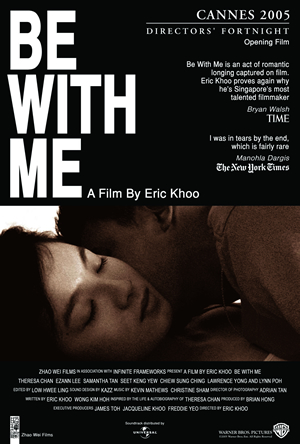
Synopsis:
“Be With Me” is a tapestry of stories woven around the themes of love, hope and destiny. The characters lead separate lives but are bound by one common desire - to be with their loved one. The protagonists in the movie are fictitious except for Theresa Chan, whose life story inspired “Be With Me.” Deaf and blind since she was 14, Theresa, now 61, has triumphed over her disabilities to live an amazing life.
Movie Review:
An elderly shopkeeper living the twilight of his years in loneliness. A timid security guard pining for unattainable love. A teenager experiencing love, and love lost. These are the 3 storylines intertwined in Be With Me, Eric Khoo's latest feature film which won accolades in Cannes 2005's Director's Fortnight. Inspired by the autobiographical life of Theresa Chan, who became blind and deaf, her tale props the others with inner strength, contrasting their fears and regrets with her courage to live life to the fullest despite her double handicap.
For the young adult audience, most should have no difficulty identifying with the puppy love stage in the So In Love segment. The initial passionate stage that lovers experience with each other, the insecurities that creep in, the fear of losing the other. As fast as love is established through a flurry of SMS messages and online chat sessions, as fast as love is lost through the cessation of communication.
Perhaps this segment is the most talked about, with the focus of love between members of the same gender. Jackie and Sam (note the androgynous names, played by Ezann Lee and Samantha Tan respectively) provide the eye-candy in a tale of modern young love. The expectation of reciprocation and committment from the other half may stifle the relationship, especially
when one is just experimenting with the other. Newcomer Samantha holds her own against the
performance of Ezann (who has TV experience), and without spoken dialogue, kudos to their performances in silence and through body language and facial expressions.
In "Finding Love", another rookie, Seet Keng Yew, stars as Fatty Koh, the timid security guard who admires Ann (played by Lynn Poh), an executive who works in the office he's guarding, from afar. Consciously aware of their social divide, he cannot bring himself to express his feelings for her, and takes to stalking her movements in the office, at play, and from the compounds of her home.
Love as seen from the perspective of the middle aged, this segment continues Eric Khoo's exploration of the working class in Singapore, following the heartlander life of Fatty, his neighbours, his unsupportive family (cult cameo favourite Lim Poh Huat appears with 3
spoken lines) and based in familiar settings like coffeeshops, HDB flats, and the kitchen.
Faced with the lack of courage for face to face communications, Fatty decides to write a letter to
Ann, and even has difficulties coming to terms with and putting down his feelings on paper. But when he finally does, the cruel hand of Fate deals a blow.
"Meant To Be" opens the film, where we see an elderly shopkeeper closing his store, and bringing the audience into the world of his private lonely life. The long wrinkled lines on his face tells you he has experienced much sorrow and loss. He cooks for himself and his wife, but the dishes remain simple. His son, a social worker, drops by only occassionally to visit,
and in one such visit, he brought along the story of Theresa Chan, inspiring his father, and through food, we see that the elderly man found new purpose in life, finally letting go of the loss and pain.
This segment is touted by many as the most powerful of all, as it mixes Theresa Chan's courageous story into itself. We wait with abated breath for the moment the two characters finally meet, and it is a scene so poignant in itself, with little said but just an embrace, bringing across forgiveness and soothe, and tears to many.
Fans of Eric Khoo's short films will know that the elderly man, played by Chiew Sung Ching, had starred in an earlier short film "Symphony 92.4FM", a role in which calls for an acting range quite similar to the one in Be With Me, a role written by Eric with Chiew specifically in mind, spending 6 months tracking him down to star in this film.
We've seen each character faced with communication challenges, and each are without physical handicap. And here lies the strength of Theresa Chan's story. Be With Me is essentially a silent film, and the use of subtitles to narrate the story of Theresa brings close to home an example of how silent and dark Theresa's world is. Physically that is. Which doesn't stop the strong lady's indomitable will to live life to the fullest, and to help others along the way.
It is simply amazing to see her go about daily chores with ease, and taking on mentorship roles in being a teacher in the school for the blind. It makes the audience sit up and ponder about life, and the naturally tendency to take our senses for granted, of being unfulfilled with many unnecessary wants and desires, forgetting the simple pleasures of life and living life.
Never had a local film touch so many facets of life, in love, sorrow, loss and inspiration. Be With Me is truly a masterful classic which commands a place in Singapore's film history. Watch this.
Posted in
Posted by
Chavara Movie Fest
at
3:21 AM
(Thursday, January 10, 2008)
Date: 19-01-2008
Venue: Chavara Cultural Centre Auditorium
Films
Posted in
Posted by
Chavara Movie Fest
at
5:13 AM